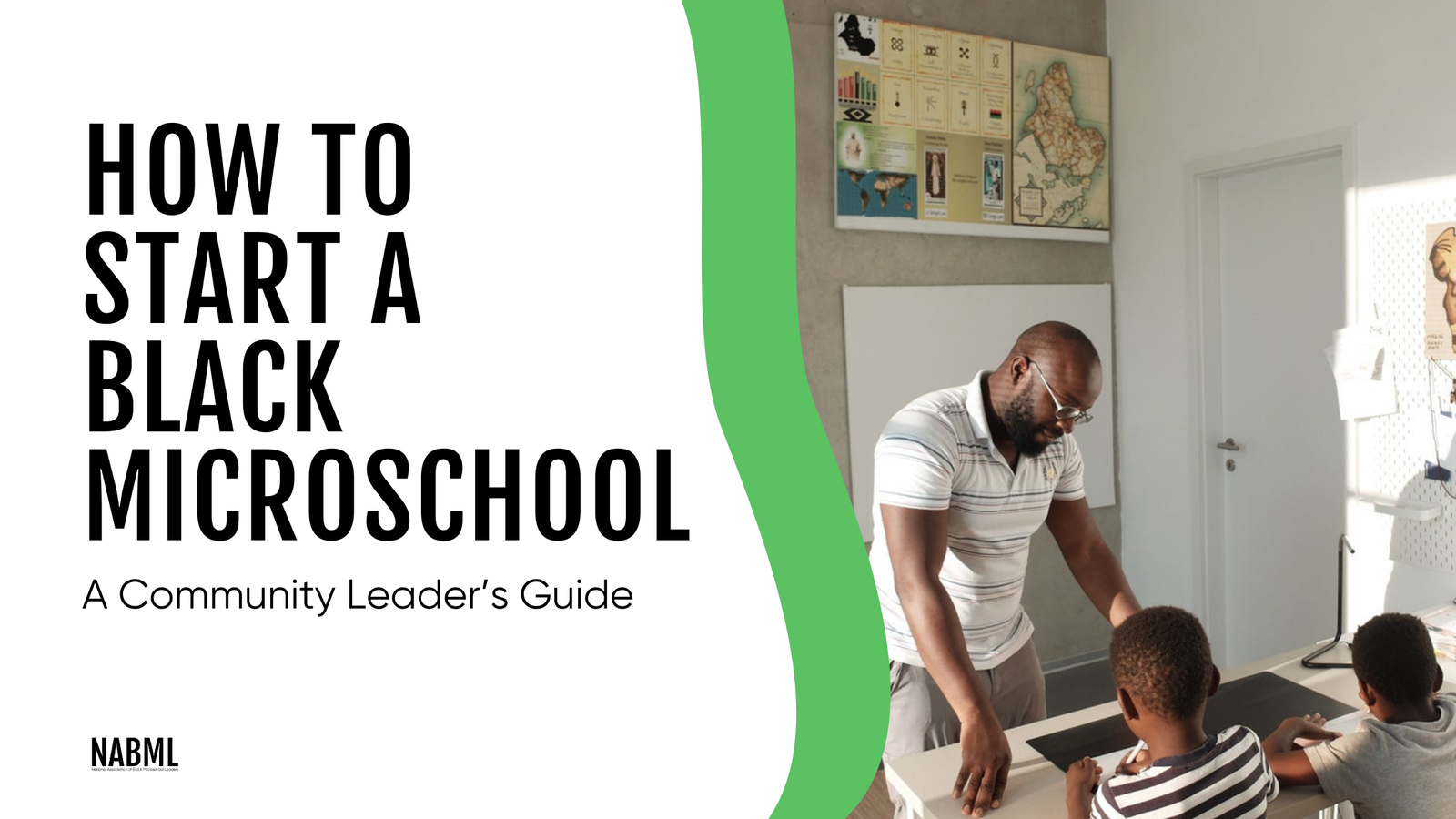
Across the country, Black parents, educators, and community leaders are arriving at the same conclusion: the traditional school system was not designed with Black children in mind. Test scores, suspension rates, and reading proficiency data tell only part of the story. The deeper reality is one of classrooms where Black children are unseen, curricula where Black history is a footnote, and school cultures where compliance is valued over the full humanity of a child.
A growing movement is answering that reality with something tangible: the Black-led microschool. Small, community-rooted, and built around the needs of the children it serves, the microschool is not a trend. It is an act of educational sovereignty.
If you have ever thought, “I could build something better for our kids,”this guide is for you. We’ll walk through what a microschool is, why Black communities are leading this charge, and the concrete steps you need to take to go from vision to open doors.
What Is a Microschool?
A microschool is a small, intentional learning environment — typically serving between 5 and 15 students — that prioritizes personalized instruction, community belonging, and a curriculum that reflects the values and identities of its students. Microschools operate in homes, churches, community centers, and commercial spaces. They may be structured full-day programs or part-time learning models. Some are tuition-based nonprofits; others are structured as LLCs or cooperatives.
What unites them is the intentionality behind them. Unlike traditional private schools — which often mirror public school models at a premium price — microschools are built from scratch, shaped entirely by what their community needs. For Black founders, that means centering African American history and culture, building trust between educators and families, and creating spaces where Black children can learn without the weight of institutional bias.
During the 2022–23 school year, an estimated 1 to 2 million students attended microschools nationwide. That number is growing rapidly, with Black-led microschools emerging as one of the fastest-growing segments of the broader educational choice movement.
Why Black Communities Are Leading the Microschool Movement
The impetus for Black-led microschooling is not rooted in trend-chasing. It is rooted in documented reality. Research consistently shows that Black students face higher rates of suspension, lower access to experienced teachers, and less representation in gifted and advanced programs. A 2022 study found that classrooms serving higher concentrations of Black and Hispanic students tend to receive lower-quality instruction — not because of the students, but because of how educational resources are distributed.
Black mothers in Arizona organized what became one of the earliest and most recognized Black-led microschool efforts. Starting in 2016 as a coalition pushing school districts to address the school-to-prison pipeline, they eventually founded their own microschool by 2021. Their story is not an anomaly — it is a pattern repeating itself in Texas, Georgia, Florida, and communities across the country.
As one Black microschool founder in Atlanta put it: she wasn’t just removing her daughter from a building — she was removing her from the consciousness of a system that was producing harm. Black-led microschools offer something the traditional system often cannot: a learning environment where Black children are not just accommodated but genuinely centered.
Step-by-Step: How to Start a Black Microschool
Step 1: Define Your Vision and Community Need
Before incorporating a legal entity or signing a lease, start with your “why.” The clearest and most durable microschools are built around a specific, deeply-felt community need. Ask yourself:
- What does the local school system currently fail to provide for Black children in my community?
- What ages and grade levels will I serve?
- What educational philosophy speaks to how I believe children learn best — project-based, Afrocentric, classical, STEM-focused, or a blend?
- What does a safe, joyful, identity-affirming learning environment look like to the families in my area?
Talk to parents in your network. Host a community design conversation — a simple gathering where parents, caregivers, and community members articulate what they want for their children. NABML’s Community Design Day model is specifically designed to help Black founders do this work in an organized, community-first way.
Step 2: Research Your State’s Legal Requirements
Microschool regulations vary significantly by state. Some states classify microschools as private schools and require formal registration and inspections. Others treat them similarly to homeschool cooperatives with minimal oversight. A few states are silent on microschools entirely, which creates both flexibility and risk.
Key questions to research in your state:
- Does your state require microschools to register as private schools?
- What are the teacher qualification requirements, if any?
- Is your state one of the 30+ with an Education Savings Account (ESA) or school voucher program, and can microschool tuition be covered?
- What health, safety, and zoning requirements apply to your intended space?
NABML’s State-by-State Guides are built specifically for Black microschool founders navigating these questions. They translate complex regulatory language into clear, actionable guidance so you can understand your legal landscape before you spend a dollar.
Step 3: Choose a Legal and Organizational Structure
Your microschool’s legal structure determines how you accept tuition, apply for grants, manage liability, and grow over time. The most common structures for microschool founders are:
- Sole Proprietorship / LLC: Simplest to set up, offers operational flexibility. Best for single-founder models in early stages. Does not allow you to accept tax-deductible donations.
- 501(c)(3) Nonprofit: Allows you to apply for grants, accept tax-deductible donations, and access certain public funding streams. Requires a board of directors and more administrative overhead, but is ideal if long-term growth and community investment are part of your vision.
- Hybrid (LLC + Fiscal Sponsorship): Some founders launch as an LLC under a fiscal sponsor — an established nonprofit that holds grants on their behalf — while building toward their own 501(c)(3) status.
NABML’s Founder Launch Lab walks founders through this decision with legal blueprints tailored specifically to Black-led educational ventures, helping you avoid costly early mistakes.
Step 4: Find and Secure Your Space
Many successful microschools begin in surprising places: a living room, a church fellowship hall, a library meeting room, or a small commercial suite. The right space is not the most expensive one — it is the one that reflects your community, meets state safety requirements, and is accessible to the families you serve.
Considerations when evaluating a space:
- Square footage and capacity for your planned student count
- Restroom access and outdoor or physical activity space
- Zoning classification — some municipalities restrict educational use in residential or certain commercial zones
- Accessibility for students with disabilities
- Proximity to the families you intend to serve — transportation barriers are real
Black church partnerships have been a particularly powerful avenue for many Black microschool founders. Black churches often have underutilized classroom-ready space, share the community values of the school, and bring immediate trust from local families.
Step 5: Build Your Financial Model and Explore Funding
One of the most common fears for aspiring microschool founders — particularly Black founders who may not have access to the same wealth networks as their white counterparts — is funding. The honest truth is that most microschools start lean and grow strategically. But there is a real and expanding landscape of funding available to community-led schools.
Tuition and Family Fees
The foundation of most microschool sustainability is tuition. Because microschools operate with dramatically lower overhead than traditional private schools, many can offer quality education at a significantly lower price point — making them more accessible to Black working-class families.
Education Savings Accounts (ESAs)
More than 30 states now have some form of ESA or school choice program, with funding averaging around $7,500 per student annually. As of 2025, 38% of microschools nationwide receive state school choice funds. Arizona’s program alone enrolled nearly 98,000 students by late 2025, and Texas launched its Education Freedom Accounts program in 2026. For Black microschool founders operating in ESA-eligible states, this is one of the most significant per-student funding tools available.
Grants for Alternative Education
Foundations dedicated to education innovation — including VELA Education Fund, which offers grants up to $10,000 for alternative education models — are specifically designed for founders like you. NABML’s Founder Launch Lab connects participants with vetted grant opportunities and helps founders build the materials needed to compete for them.
Community Investment and Philanthropy
NABML operates as a venture philanthropy — meaning we invest directly in founders who are ready to launch. Our Founder Launch Lab participants are featured on our website as active investment opportunities, allowing donors and philanthropists to fund specific schools and founders they believe in. This is a departure from the traditional grant model: it is direct, personal investment in Black community-led innovation.
Step 6: Design Your Curriculum and Hiring Plan
Unlike traditional public schools, microschools are not required to follow a state-mandated curriculum in most jurisdictions. This is both a freedom and a responsibility. As a Black microschool founder, your curriculum is one of the most powerful levers you have to shape what your students experience, believe about themselves, and understand about the world.
Consider curriculum frameworks that center the following:
- Culturally sustaining pedagogy — instruction that affirms students’ cultural identities as assets, not obstacles
- African American history and literature as core content, not supplemental material
- Social-emotional learning that is grounded in the lived experiences of Black children
- Project-based, experiential learning that develops critical thinking and real-world competency
On staffing: many small microschools are founded and led by a single educator, sometimes with a part-time assistant. As you grow, intentional hiring that prioritizes educators with cultural competency — not just credentials — will shape the long-term identity of your school.
Step 7: Build Community and Enroll Your First Families
Your first families are your most important advocates. In the early stages, enrollment is almost entirely word-of-mouth — which is both a challenge and an asset. Black families, particularly those who have been failed by traditional school systems, do not trust marketing. They trust people they know.
Practical early enrollment strategies:
- Host information sessions in trusted community spaces — churches, barbershops, community centers
- Offer open observation days so families can see your vision in action before committing
- Be transparent about what you can and cannot offer — integrity builds trust faster than polished brochures
- List your school in the NABML Microschools Directory, where Black families specifically searching for community-led schools can find you
How NABML Supports Black Microschool Founders
The National Association of Black Microschool Leaders exists because the journey to founding a school is hard — and it is made harder when you are building without the institutional support that has historically flowed toward other communities. NABML is built to close that gap.
Here is how we support founders at every stage:
- Founder Launch Lab: Our flagship incubation program provides aspiring founders with legal blueprints, a structured launch strategy, operational support, and connection to a national network of fellow Black microschool leaders.
- State-by-State Guides: Plain-language breakdowns of the regulatory environment in each state, so founders know exactly what they are walking into.
- NABML Certification: A nationally recognized quality standard that signals to families, funders, and partners that your microschool meets rigorous benchmarks for excellence.
- NABML Ops: Back-office infrastructure support — from financial management to compliance — so founders can focus on teaching and community.
- Microschools Directory: A public-facing directory that connects your school to Black families actively searching for community-led alternatives.
Frequently Asked Questions
Do I need to be a certified teacher to start a microschool?
In most states, no. Microschool founders do not need a teaching license unless they choose to register as a formal private school in states that require it. That said, having an educational background or partnering with a credentialed educator can strengthen your school’s credibility with families and certain funders.
How many students do I need to start?
Many microschools launch with as few as 4–8 students. Starting small allows you to build your model, earn family trust, and refine your approach before scaling. It also reduces your financial risk in the early months.
Can families use ESA or voucher funds at my microschool?
In most states with ESA programs, yes — provided your school meets the program’s eligibility requirements. Requirements vary by state, and some states require accreditation or formal registration. NABML’s state guides can help you determine what applies in your jurisdiction.
How is a microschool different from homeschooling?
A microschool is a multi-family learning environment with a dedicated teacher or learning guide, a structured daily schedule, and intentional curriculum. Homeschooling typically involves a parent educating their own children at home. Microschools are distinct in that they serve multiple families and create a shared learning community.
How do I get my microschool listed in the NABML directory?
Visit directory.nabml.org and submit your school’s information. The directory is specifically built to connect Black families with community-led microschools, and listing is available to NABML members and certified schools.
Your Community Needs What You Are Building
Starting a Black microschool is not a small thing. It is an act of love, strategy, and resistance. It is a declaration that your community’s children deserve more than what the system has offered — and that you are willing to build it.
You do not have to do it alone. NABML exists to stand alongside Black microschool founders at every step — from the initial idea to open enrollment and beyond. Whether you are ready to apply to the Founder Launch Lab, curious about what starting a microschool looks like in your state, or simply looking for a community of people who understand this work, we are here.
Ready to start? Explore the Founder Launch Lab.